From collection and recovery to use and ongoing operation.
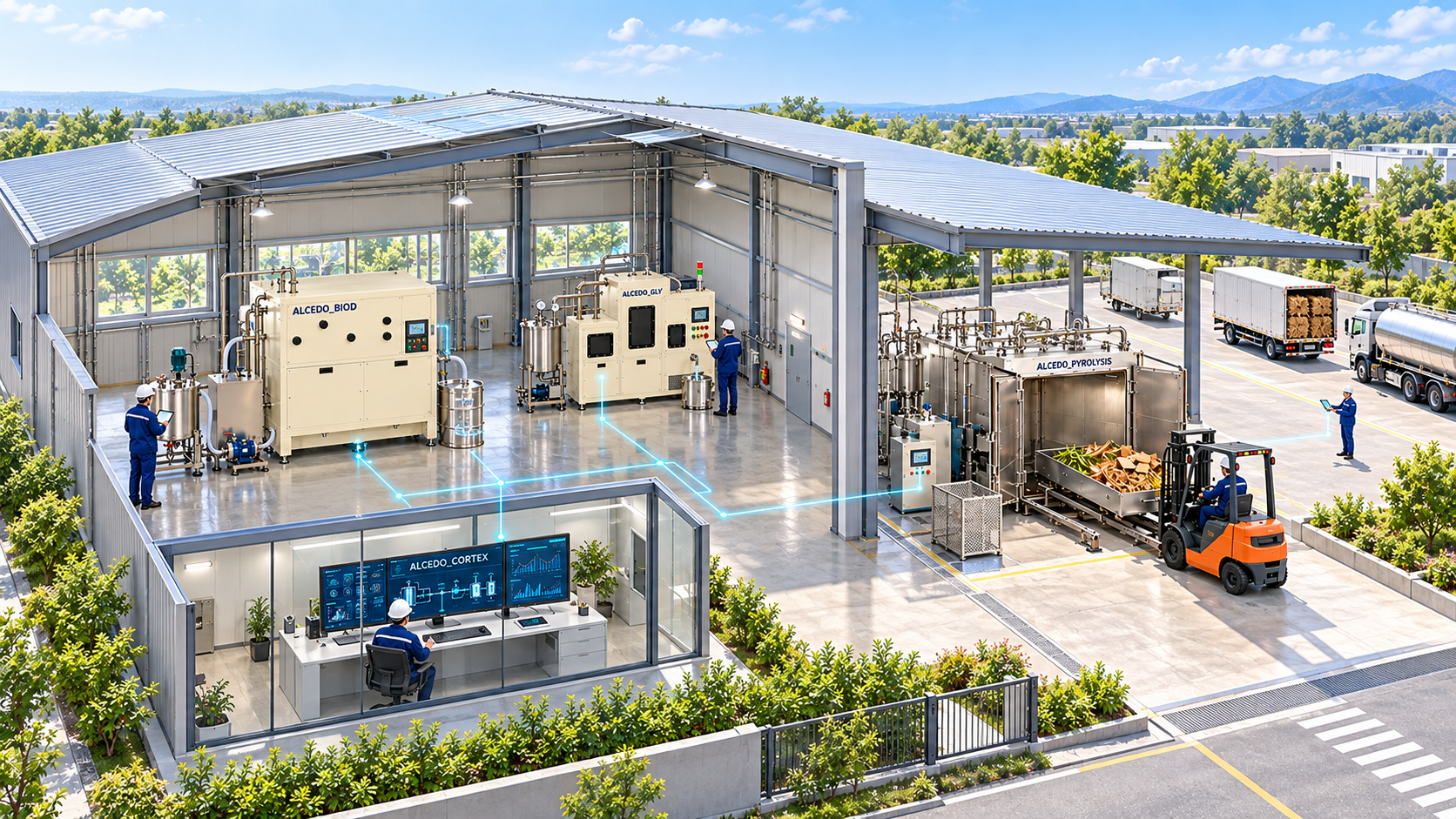
ALCEDO_CIRCULAR concept illustration. It does not depict an actual installation or layout.
01 / CIRCULAR
Local resources, for local use.
We assess the volume and properties of used cooking oil and residues, then select suitable equipment and end users. Each site is planned from collection through ongoing operation.
01
Collection
Check feedstock volume and properties, and supply reliability.
02
Recovery
Select suitable equipment and operating methods.
03
Use
Check quality, acceptance criteria and intended uses.
04
Ongoing Operation
Assess maintenance, records, contracts and financial viability.
A processing route for each feedstock.
Used cooking oil and other suitable oils→ALCEDO_BIOD→Biodiesel fractionQuality checks and end-use selection
Separated in BIOD Crude glycerin→ALCEDO_GLY→Refined glycerin and other recovered materialsComposition checks and use assessment
Suitable local residues→ALCEDO_PYROLYSIS→Char and other recovered materialsComposition checks and use assessment
ALCEDO_CORTEX: a concept linking feedstock, operation, quality and shipment records to support human review and decisions.
02 / PRODUCTS & TECHNOLOGY
Resource recovery technology, matched to your needs.
Equipment and configurations are assessed against required throughput, recovered-product quality and installation conditions.
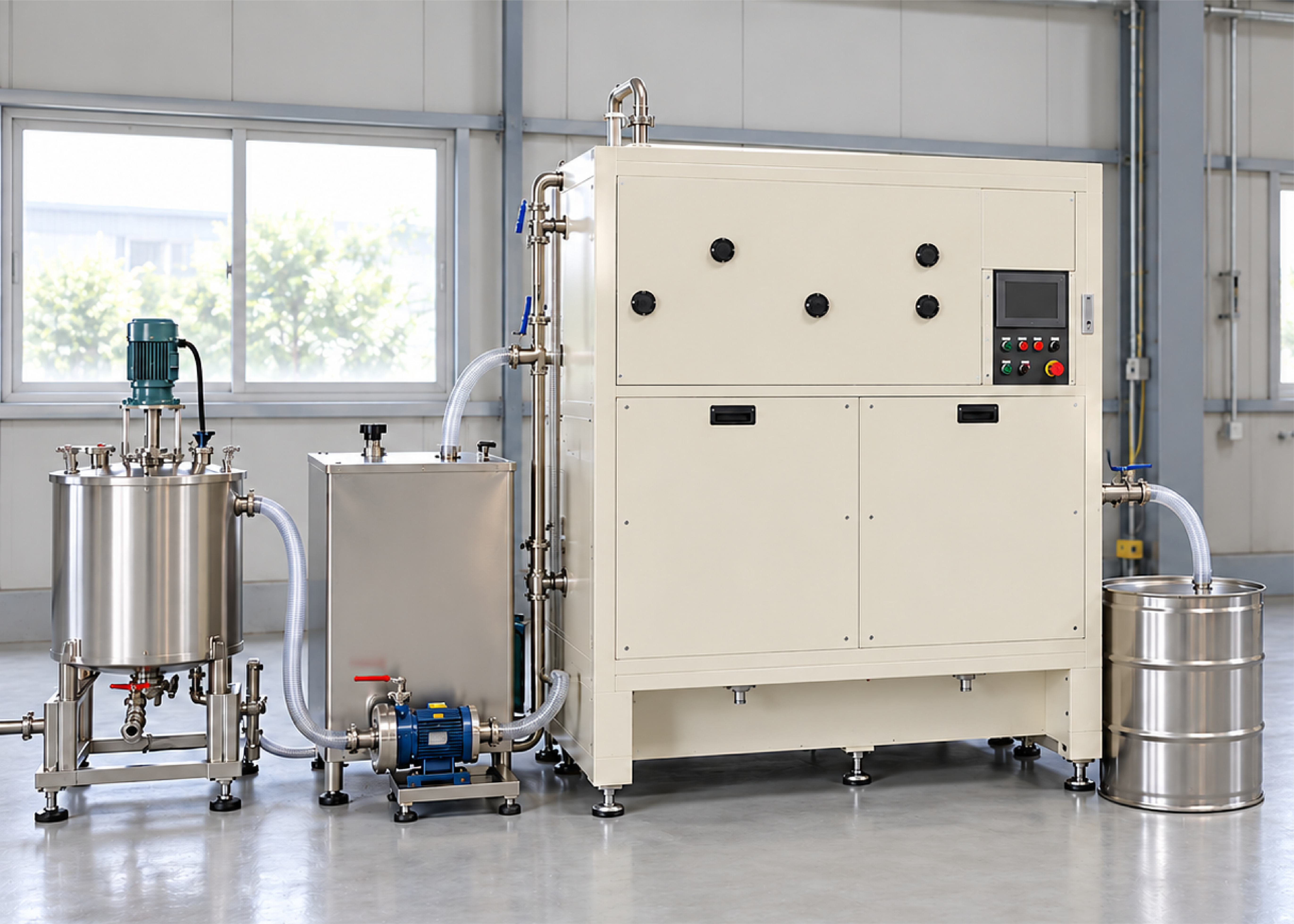
Equipment illustration from supplied materials. It does not guarantee current specifications.
BIOFUEL
ALCEDO_BIOD
Produce and refine biodiesel from used cooking oil and other suitable oils.
Feedstock oil undergoes reaction, separation and vacuum distillation to recover a biodiesel fraction. Refining the separated crude glycerin in a standalone GLY unit is considered separately.
Fuel use is determined after checking batch quality and the receiving equipment's acceptance requirements.
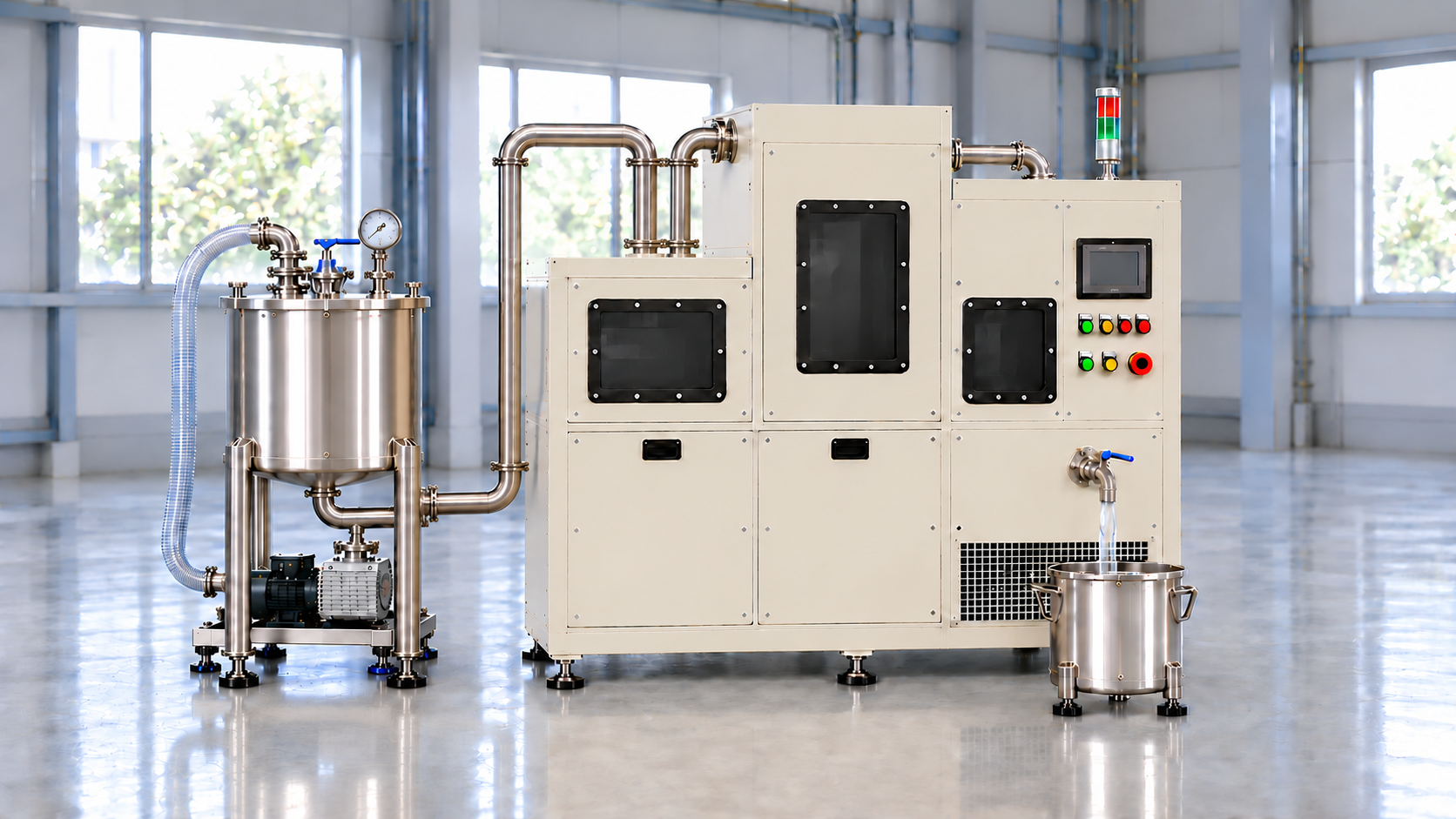
Approved exterior illustration. Approval does not verify physical equipment specifications.
GLYCERIN RECOVERY
ALCEDO_GLY
Recover useful resources from crude glycerin.
A standalone unit for pretreating, separating and refining crude glycerin from the BIOD process. Potential uses as feedstock or fuel are assessed against composition and end-user requirements.
Pretreatment → Separation → Refining and recovery → Composition checks
Purity, recovery rate and throughput must be verified for each feedstock.
RESOURCE RECOVERY
ALCEDO_PYROLYSIS
Three configurations to assess against your feedstock and site.
Suitable residues are treated with superheated steam to recover char and other materials. Batch or continuous operation, and stationary or vehicle-mounted configurations, are selected according to feedstock properties, volumes and site conditions.
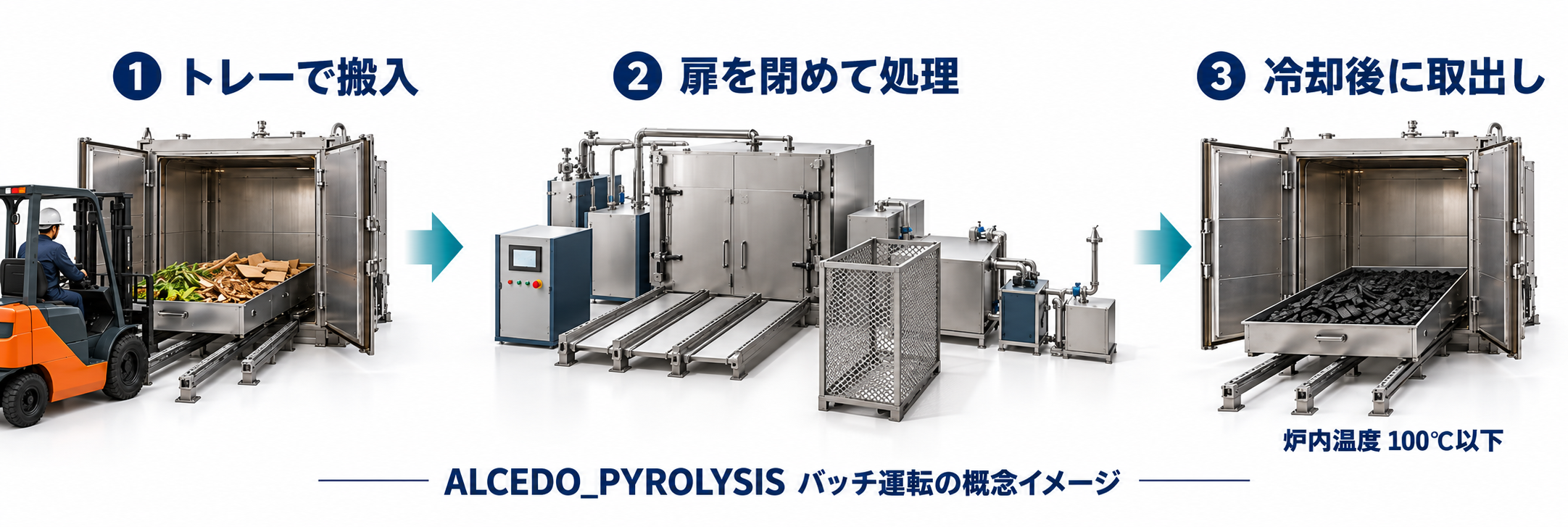
Batch-operation concept illustration. Japanese labels show loading, treatment and unloading after cooling. The temperature shown is illustrative; unloading conditions require feedstock-specific review.
01 / BATCH
BPR | Batch Pyrolysis Reactor
Stationary
Feedstock is loaded on trays and treated with the doors closed. After cooling, trays are removed and char or other recovered materials are collected.
Tray loading → Treatment → Cooling → Unloading and recovery
Plan trays, handling equipment, door clearance, loading and recovery routes, and maintenance space together.
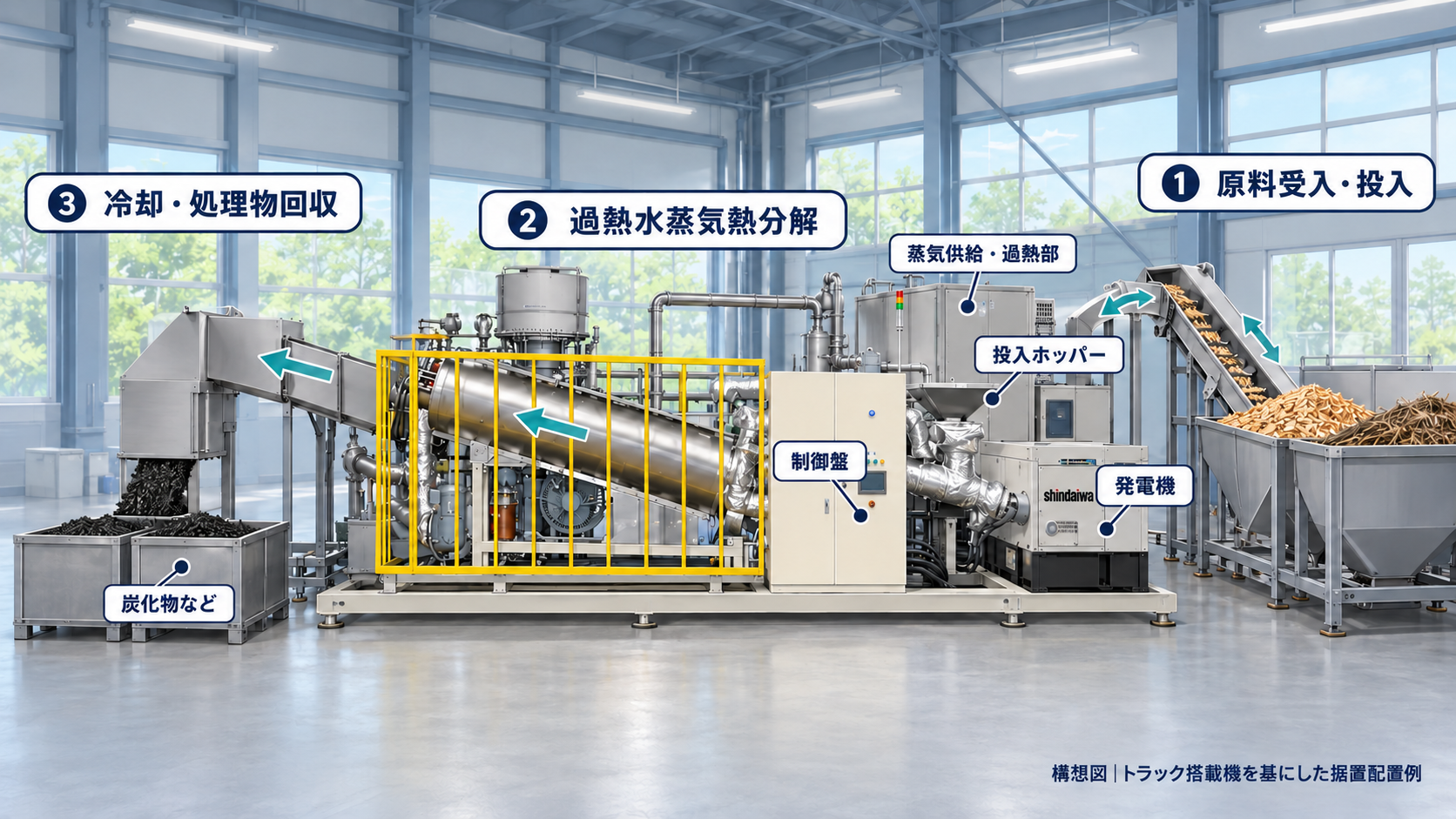
Stationary layout concept based on the vehicle-mounted unit. Japanese labels identify feeding, steam treatment, cooling and recovery. Equipment and auxiliary configurations require individual review.
02 / CONTINUOUS · STATIONARY
CPR | Continuous Pyrolysis Reactor
Stationary
A continuous process is arranged within the factory, from feedstock supply through superheated-steam treatment to cooling and recovery.
Feedstock supply → Treatment → Cooling and recovery
Check feedstock handling, steam, power, cooling and exhaust connections, recovery equipment and maintenance access.
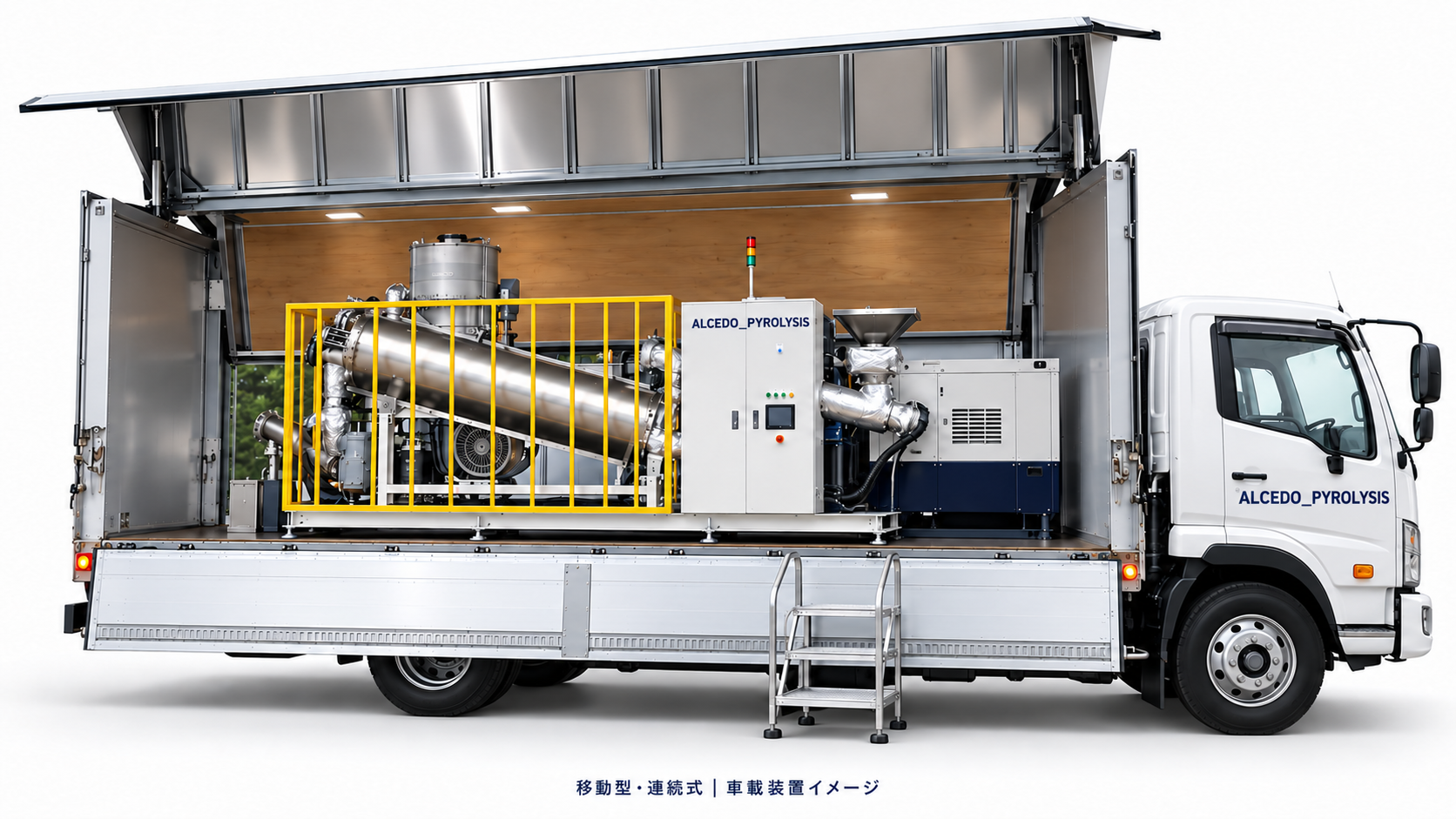
Vehicle-mounted concept illustration. Vehicle specifications, mounted equipment and connections are defined individually.
03 / CONTINUOUS · MOBILE
CPR | Continuous Pyrolysis Reactor
Vehicle-mounted
Operation at the feedstock source is considered by moving the unit to the site. Mounted equipment and external supply and recovery facilities are designed separately.
Site setup and connections → Feedstock supply → Treatment, cooling and recovery
Check vehicle dimensions and weight, parking and working areas, external steam and power supplies, and feedstock supply and recovery arrangements.
BPR stands for Batch Pyrolysis Reactor; CPR stands for Continuous Pyrolysis Reactor. Throughput, temperature and dimensions are defined for each model and feedstock. Images are concepts and do not guarantee physical equipment specifications or performance. Recovered-material uses depend on composition and acceptance criteria.
03 / ALCEDO_CORTEX
Connect documents and records. Support on-site decisions.
An AI and data platform concept bringing together procedures, operating records, quality results and past responses. Staff review the evidence, make decisions, take action and record outcomes.
01
Find Information
Present relevant procedures and response histories together with their sources.
02
Review Evidence
Link feedstock, operations and quality, identifying checks to make and missing information.
03
Keep Records
Draft daily reports for staff to check figures and supporting evidence before approval.
Start with one selected line. Compare time, errors and review workload using the same tasks as existing procedures. Results inform whether to move gradually to on-site edge infrastructure.
People decide. PLCs and other control systems handle equipment and safety. Benefits and performance will be assessed in a proof of concept. PLC command integration, optimization and predictive maintenance are later-stage considerations.
04 / APPLICATIONS
Explore more uses, for each local feedstock.
Explore fuels, biochar and materials from agricultural and food-processing oils and residues. Recovery potential is assessed against feedstock properties and end-use requirements.
Feedstock illustration (AI-generated)
Application concept
Coffee Cherries
Recovering resources from pulp and skins
Feedstock
Pulp, skins and husks remaining after bean removal. These are assessed separately from spent coffee grounds.
Application concept
Collect, sort and adjust feeding conditions, then carbonize through pyrolysis and assess recovered-product quality.
Business aim
Assess agricultural use and solid fuel applications, linking residue handling at processing sites with local end users.
Potential uses: agricultural biochar / solid fuel
Check feedstock volumes and seasonality, pretreatment requirements, char composition and safety, and field application conditions. Colombia is a candidate setting for a trial.
Feedstock illustration (AI-generated)
Application concept
Oil Palm
Recovering resources from milling residues
Feedstock
Empty fruit bunches (EFB), fibers and palm kernel shells from oil milling. Liquid effluent is handled in a separate process.
Application concept
Collect each residue stream, remove contaminants and adjust feeding conditions before pyrolysis. Separate and evaluate recovered char and other materials.
Business aim
Assess solid fuel and soil amendment uses, comparing them with existing fuel use and composting to identify a viable recovery route.
Potential uses: solid fuel / soil amendments
Check fiber handling, ash and residual oil, product quality, heat balance, emissions and competition with existing uses.
Feedstock illustration (AI-generated)
Application concept
Rice
Separate routes for rice bran oil and residues
Feedstock
Non-food-grade or waste rice bran oil and defatted rice bran. Rice husks and straw are managed as separate feedstock groups.
Application concept
Assess oil pretreatment, reaction and BIOD refining for biodiesel, and pyrolysis of solid residues for char and other materials. Evaluate the two routes separately.
Business aim
Assess local biodiesel use and solid fuel or material uses for residues. Compare against the value of edible oil or animal-feed uses where applicable.
Check collection, storage, pretreatment requirements, and char composition and safety. Adsorbent applications require additional processing and application-specific testing.
Evaluate potential value for each feedstock.
We aim to reduce residue-handling burdens, recover fuels and materials, and connect with local users. Evaluation covers soil effects and safety for agricultural uses, quality and energy balance for fuels, and application-specific performance for materials.
These are application concepts. General research findings are not evidence of ALCEDO equipment performance. Performance, economics and environmental benefits require feedstock-specific verification; uses depend on test results and acceptance criteria.
PROJECT / CAMBODIA
Cambodian rice husks. Biochar for local use.
ALCEDO will participate in Asian Gateway's decarbonization project as a partner evaluating superheated-steam pyrolysis technology.
Project lead
Feasibility study (FS)
Assess technology and operating conditions for local feedstock.
ALCEDO will evaluate the pyrolysis characteristics of Cambodian rice husks, equipment specifications and suitability for local operation. The wider project explores combining agricultural biochar use with methane reduction through paddy water management.
Feedstock
Rice husks from milling
→
ALCEDO's role
Evaluate pyrolysis characteristics, specifications and local suitability
→
Project goals
Assess agricultural use, carbon storage and commercial feasibility
The project is at the feasibility-study stage. Commercial operation, agronomic benefits, emission reductions and credit issuance are not confirmed.
Funding and related studies
Asian Gateway's proposed project was selected under Japan's Ministry of Economy, Trade and Industry FY2025 Supplementary Budget Global South Future-Oriented Co-Creation Project Subsidy (Small-Scale Demonstration / Feasibility Study Program). Grant approval was received on September 18, 2026.
An integrated model is being explored alongside Asian Gateway's separate AWD study supported by Japan's Ministry of Agriculture, Forestry and Fisheries. Alternate Wetting and Drying (AWD) manages paddy water intermittently rather than maintaining continuous flooding. Measurement, reporting and verification requirements are also assessed toward potential use under the Joint Crediting Mechanism (JCM).